Military Lending Act Compliance: A Practical Guide for Lenders

Key Takeaways
- The Military Lending Act (MLA) caps the Military Annual Percentage Rate (MAPR) at 36% on most consumer credit extended to active-duty service members and their covered dependents (as of November 2026).
- The MLA excludes residential mortgages, home equity loans, and purchase-money auto loans secured by the vehicle being bought.
- Lenders get the MLA safe harbor only when they check covered borrower status through the Department of Defense's MLA database or a consumer report from a nationwide consumer reporting agency. Asking the applicant does not qualify.
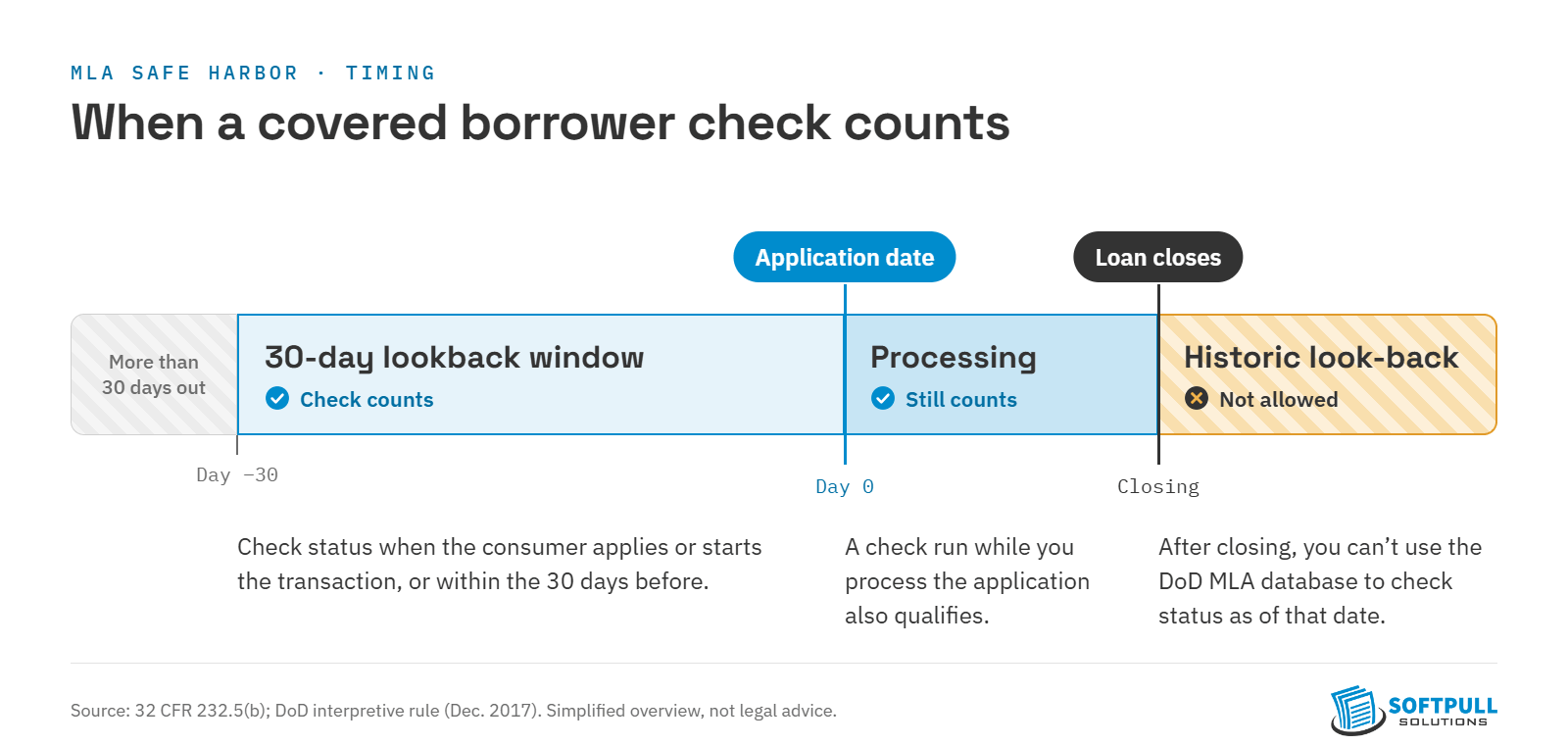
- To keep the safe harbor, the check must be run when the consumer applies or starts the transaction, or within the 30 days before.
- A credit contract that violates the MLA is void from inception, and knowing violations can carry criminal penalties.
The Military Lending Act (MLA) is a federal law that limits the cost and terms of consumer credit extended to active-duty service members, their spouses, and certain dependents. For lenders, Military Lending Act compliance comes down to three tasks: identify covered borrowers before the loan is made, keep the Military Annual Percentage Rate at or below 36%, and avoid the contract terms the law prohibits.
The law reaches further than many lenders expect. Since 2016, it has applied to most consumer credit covered by the Truth in Lending Act, so a lender that never markets to military customers still sees covered applicants.
This guide covers who qualifies as a covered borrower, which loans the MLA applies to, what the law requires, and how to build the covered borrower check into your origination workflow.
What Is the Military Lending Act?
The Military Lending Act is a federal law, codified at 10 U.S.C. 987, that limits the cost and terms of consumer credit offered to active-duty service members and their dependents. Congress passed it in 2006, and the Department of Defense (DoD) implements it through its regulation at 32 CFR Part 232.
The original rule was narrow. It applied to three products: short-term closed-end payday loans, short-term vehicle title loans, and tax refund anticipation loans.
That changed with DoD's July 2015 final rule, which extended the MLA to most closed-end and open-end consumer credit. Most creditors had to comply by October 3, 2016, and credit card issuers by October 3, 2017. The 2015 rule also replaced the old self-declaration form with today's database and credit-report methods for identifying covered borrowers.
The rules may change again. In June 2026, the House Armed Services Committee's version of the FY2027 National Defense Authorization Act included report language directing DoD to review the MLA regulations. Lenders should watch for updates.
Who Qualifies as a Covered Borrower?
A covered borrower is a consumer who, at the time they take on the credit or open the account, is an active-duty service member or a dependent of one. Status is fixed at that moment. It's the borrower's status on the day of the transaction that matters, not their status later.
According to the Consumer Financial Protection Bureau (CFPB), covered borrowers include:
- Active-duty members of the Army, Marine Corps, Navy, Air Force, Coast Guard, and Space Force
- Members of the Reserves serving on active duty
- Members of the National Guard mobilized under federal orders for more than 30 consecutive days
- Spouses of those service members
- Certain other dependents, as defined in federal law
Under the regulation's definitions, "active duty" means orders that don't specify a period of 30 days or fewer, plus Active Guard and Reserve duty.
The MLA does not cover veterans, military retirees, or Guard and Reserve members who aren't on qualifying active duty. A service member's status can also change over time, which is one reason lenders verify status at application rather than relying on what an applicant says.
What Loans Are Covered Under the Military Lending Act?
The MLA covers most consumer credit. The regulation defines consumer credit as credit for personal, family, or household purposes that either carries a finance charge or is payable in more than four installments.
That test pulls in credit cards, personal loans, and lines of credit. Credit with no finance charge that's paid in four or fewer installments falls outside it.
The regulation then carves out specific exceptions. The table below shows how common credit types are treated.
|
Credit type |
Covered by the MLA? |
Notes |
|---|---|---|
|
Credit cards |
Yes |
Covered since October 3, 2017 |
|
Payday loans and deposit advances |
Yes |
Includes short-term, single-payment products |
|
Vehicle title loans |
Yes |
Non-bank creditors can't use a vehicle title as security for covered borrowers |
|
Tax refund anticipation loans |
Yes |
|
|
Unsecured installment and personal loans |
Yes |
|
|
Unsecured open-end lines of credit |
Yes |
Includes overdraft lines of credit, but not traditional overdraft fees |
|
Private student loans |
Sometimes |
Depends on the loan structure |
|
Pawn loans |
Yes |
|
|
Residential mortgages, refinances, HELOCs, and reverse mortgages |
No |
Excluded when secured by a dwelling |
|
Auto loans to buy a vehicle, secured by that vehicle |
No |
Extra financing can complicate this (see below) |
|
Loans to buy personal property, secured by that property |
No |
Example: an appliance financed at the point of sale |
|
Business-purpose credit |
No |
Exempt from Regulation Z, so outside the MLA |
Sources: 32 CFR 232.3, 32 CFR 232.8, and the CFPB. For a specific product, the CFPB publishes an MLA applicability flowchart.
Does the MLA Apply to Mortgages?
No, in most cases. The MLA excludes residential mortgages, defined as credit secured by an interest in a dwelling. That includes loans to buy or build a home, refinances, home equity loans and lines of credit, and reverse mortgages.
Mortgage lenders still have servicemember obligations under other laws. The Servicemembers Civil Relief Act (SCRA) protects home loans and other debts a servicemember took on before entering active duty.
Auto Loans and the Purchase-Money Exception
A loan made to buy a vehicle, and secured by that vehicle, is excluded from the MLA. The exception depends on what the loan finances.
These auto-related loans are generally outside the exception:
- Vehicle title loans, where an owned vehicle secures new credit
- Refinances of an existing auto loan, since the credit no longer finances a purchase
- Purchase loans that also put cash in the borrower's hands, since that money isn't financing the purchase
Add-on products are less settled. DoD guidance from December 2017 said financing GAP coverage disqualified a loan from the exception. DoD withdrew that guidance on February 28, 2020.
In 2023, the Fourth Circuit held in Davidson v. United Auto Credit Corp. that financing GAP and related costs did not remove a purchase loan from the exception. However, DoD, the CFPB, and the Department of Justice argued the opposite in that case, and some states regulate GAP sales to service members separately.
Dealerships and auto lenders should seek counsel's view on how to structure add-ons for covered borrowers.
What the MLA Requires of Lenders
When a loan is covered and the borrower is a covered borrower, the lender has three sets of obligations: a rate cap, specific disclosures, and a list of prohibited terms.
The 36% MAPR Cap
A creditor can't charge a covered borrower more than a 36% MAPR (as of November 2026). The MAPR is not the same number as the annual percentage rate (APR) under the Truth in Lending Act. It pulls in costs the standard APR often leaves out.
According to the CFPB, the MAPR calculation includes:
- Finance charges
- Credit insurance premiums
- Add-on credit-related products sold in connection with the credit
- Fees such as application fees, participation fees, and debt cancellation fees
This is where many violations start. A loan with a 30% interest rate can exceed 36% once a membership fee or add-on product enters the calculation.
Required Disclosures
Before or when the borrower becomes obligated, the lender must provide:
- A statement of the MAPR (the regulation includes model language, and a numeric MAPR isn't required)
- The disclosures required by Regulation Z
- A clear description of the borrower's payment obligation
These must be given in writing in a form the borrower can keep. The MAPR statement and payment description must also be given orally, and lenders may meet that requirement with a toll-free number the borrower can call. See 32 CFR 232.6 for the full requirements.
Prohibited Terms
Under 32 CFR 232.8, a covered loan cannot:
- Require the borrower to submit to arbitration
- Require the borrower to waive legal rights, including rights under the SCRA
- Demand unreasonable notice before the borrower can take legal action
- Require a military allotment as a condition of the loan
- Charge a prepayment penalty or prohibit prepayment
- Use a check or other access to the borrower's deposit account, with narrow exceptions for EFT repayment, direct deposit, and certain security interests
Two more limits apply only to non-bank lenders. Payday-type lenders can't roll over or refinance their own covered loans with new credit, and non-bank creditors can't take a vehicle title as security.
How to Check Covered Borrower Status and Qualify for Safe Harbor
An MLA covered borrower check is how a lender determines, before the loan is made, whether the applicant is protected by the MLA. The check matters because the lender carries the risk. If a covered borrower gets a non-compliant loan, the contract can be void even if the lender never knew the borrower was in the military.
Why a Self-Declaration Isn't Enough
The regulation lets a lender use any method it wants to identify covered borrowers. Only two methods, however, give the lender a safe harbor: a determination that is treated as conclusive for that transaction.
Asking applicants to check a box doesn't qualify. DoD dropped the self-declaration safe harbor in its 2015 rule, citing cases where service members falsely declared they weren't covered.
The Two Safe Harbor Methods
Under 32 CFR 232.5, a lender qualifies for the safe harbor by checking status through either:
- The DoD's MLA database, maintained by the Defense Manpower Data Center (DMDC) at dmdc.osd.mil/mla. A search requires the consumer's last name, date of birth, and Social Security number. DoD guidance also allows an Individual Taxpayer Identification Number for dependents without an SSN.
- A consumer report from a nationwide consumer reporting agency, or a reseller of that report, that contains a covered borrower status indicator.
|
Method |
How it works |
Inputs |
Workflow fit |
Safe harbor |
|---|---|---|---|---|
|
DMDC MLA website |
Lender searches the DoD database directly, one record or in batches |
Last name, date of birth, SSN (or ITIN) |
Separate manual step outside the loan system |
Yes |
|
MLA indicator on a credit report |
Covered borrower status is returned with the applicant's consumer report |
Set by the bureau or reseller |
Runs in the same request as the credit pull |
Yes, when the report comes from a nationwide CRA or reseller |
|
Standalone MLA status report |
Status check without a full credit report, from a CRA or reseller |
Set by the bureau or reseller |
Can run on its own or be added to a credit pull |
Yes, when it comes from a nationwide CRA or reseller |
|
Applicant self-declaration |
Applicant states whether they're on active duty |
None |
Simple, but unreliable |
No |
When relying on a credit-report indicator, some practitioners recommend submitting all the inputs the DMDC search requires (last name, date of birth, and SSN) for added protection. A 2022 federal court decision examined this distinction between the two safe harbors.
Timing: The 30-Day Window
The safe harbor depends on when the check runs. A lender can rely on a check made:
- When the consumer initiates the transaction or applies to open the account
- Within the 30 days before that
- While the lender is processing the application, per DoD's December 2017 interpretation (Q&A #20)
For firm offers of credit that use covered borrower status as a criterion, a check made when the offer is developed holds if the consumer responds within 60 days.
Two timing rules catch lenders off guard. First, the check applies to that transaction or account only, so a new loan to a returning customer needs a new check. Second, a lender can't run the DoD database after the fact to establish status as of an earlier transaction date. This is the regulation's prohibition on "historic lookback."
Keep the Record
The safe harbor holds only if the lender creates a record of the check at the time and keeps it. Store the result, the date, and the method alongside the loan file.
A clean check has limits. It tells you whether the borrower is covered, but the loan still has to meet the MAPR cap, disclosure rules, and term restrictions.
Building MLA Checks Into Your Origination Workflow
The most reliable place for the covered borrower check is inside the application flow, before terms are presented. An automatic check on every applicant removes the judgment call about who "looks" military, and it lands inside the safe harbor window by default.
How this looks depends on the lender's products and systems. Here's one example for an installment lender:
- The applicant applies. The lender collects identifying information and the consumer's authorization for the credit check, with a permissible purpose for any report it pulls.
- The MLA check runs. Covered borrower status is requested alongside the credit report, or as a standalone check, at the time of application.
- Not covered: The application moves through the standard product path.
- Covered: The application routes to an MLA-compliant path. That means a MAPR test that includes all fees and add-ons, MLA disclosures, and a contract without arbitration or other prohibited terms.
- The result is saved with the loan file, including the date and method.
Some lenders don't offer a product that fits within the MLA's limits. In that case, the lender may decline the application, and any adverse action notice requirements still apply.
Timing also matters for lenders that prequalify. If a consumer prequalifies more than 30 days before submitting a full application, the check should run again at application.
Adding the MLA Check With Soft Pull Solutions
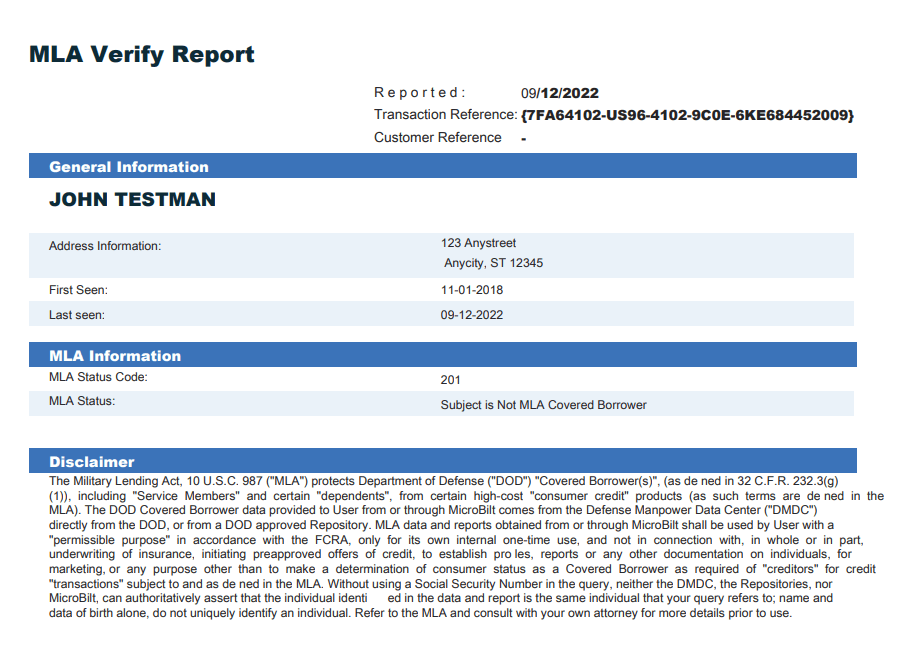
Soft Pull Solutions offers MLA Verify, which confirms covered borrower status against the Department of Defense's database. Lenders can run it as a standalone report or add it to a credit report, so the check fits into an existing pull rather than becoming a separate manual step.
MLA Verify returns:
- Confirmation of MLA-covered borrower status
- The most recent name and address of record for the applicant
It's built for the origination of credit the MLA regulates, including closed-end short-term loans, payday loans, vehicle title loans, and tax refund anticipation loans.
The image below shows a sample report of MLA Verify:
Penalties for Violating the MLA
The MLA's remedies are severe because they reach the loan itself. Under 32 CFR 232.9:
- A credit contract that violates the MLA, or contains a prohibited term, is void from inception.
- Arbitration agreements are unenforceable against covered borrowers.
- Borrowers can recover actual damages of at least $500 per violation, plus punitive damages, equitable relief, and attorney fees.
- A creditor that knowingly violates the MLA commits a misdemeanor, punishable by a fine, up to one year in prison, or both.
There is a narrow defense for unintentional, bona fide errors, such as calculation or programming errors, when the lender maintained procedures to prevent them.
Enforcement has continued through recent changes at the CFPB. In November 2025, a federal court entered a settlement between the CFPB and fintech lender MoneyLion over allegations that it charged covered borrowers rates above the MLA's cap. Private lawsuits and state regulators add further exposure.
Frequently Asked Questions
Does the Military Lending Act apply to mortgages?
No. The MLA excludes residential mortgages, meaning credit secured by a dwelling. That includes purchase loans, construction loans, refinances, home equity loans, HELOCs, and reverse mortgages. Servicemembers may still have protections under the Servicemembers Civil Relief Act.
Does the MLA apply to auto loans?
It depends on the loan. A loan to buy a vehicle that is secured by that vehicle is excluded. Vehicle title loans, auto refinances, and purchase loans that include cash to the borrower generally fall outside the exception. Whether financing GAP coverage affects the exception is not fully settled.
Does the Military Lending Act apply to veterans?
No. The MLA protects active-duty service members, qualifying Guard and Reserve members on active duty, and their covered dependents. Veterans and military retirees are not covered borrowers.
Is a covered borrower check required?
The regulation doesn't require a specific check, but the MLA applies to every covered borrower whether or not the lender identifies them. A check through the DoD's MLA database or a nationwide credit bureau report is the only way to get the safe harbor, so many lenders check every applicant for covered credit.
How long is an MLA covered borrower check valid?
A check applies to one transaction or account. To qualify for the safe harbor, it must run when the consumer applies or initiates the transaction, within the 30 days before, or while the application is being processed. A new loan requires a new check.
Does the MLA apply to business loans?
No. The MLA covers consumer credit, meaning credit for personal, family, or household purposes. Business-purpose credit is exempt from Regulation Z and outside the MLA.
Make MLA Checks Part of Every Application
Military Lending Act compliance starts with knowing who you're lending to. With MLA Verify from Soft Pull Solutions, you can confirm covered borrower status as a standalone report or alongside a credit report, at the point in your workflow where it protects you most.
Schedule a demo or call (844) 515-1550 to add MLA Verify to your origination process.
This article is for informational purposes only and does not constitute legal advice. Consult a qualified attorney regarding your specific compliance obligations.


